Mindfulness-Based Interventions for Health and Well-Being
/Mindfulness-Based Interventions for Health and Well-Being
Mindfulness-based interventions include slow controlled breathing, mindfulness meditation, cognitive–behavioral therapies, biofeedback, guided imagery and physical activities such as yoga, tai chi, and qigong. These activities may be used to increase self-awareness, relieve stress, and improve interoception (the sense of the body’s internal state).
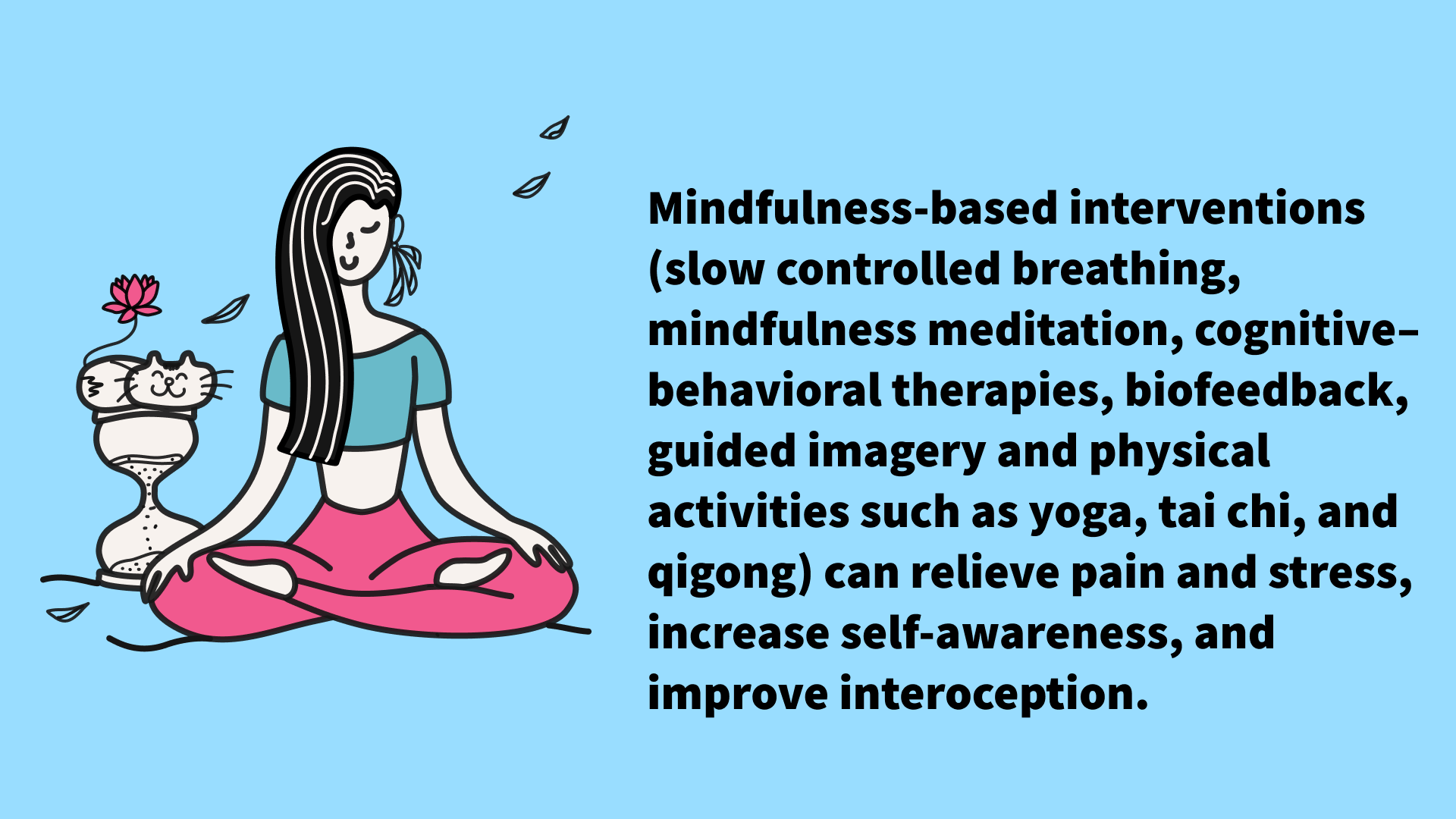
Mindfulness-based interventions include slow controlled breathing, mindfulness meditation, cognitive–behavioral therapies, biofeedback, guided imagery and physical activities such as yoga, tai chi, and qigong.
Mindfulness-Based Interventions and Pain Management
There are many ways that people can practice mindfulness-based interventions, some common ways are through yoga, meditation, exercise and even mindful colouring. There are also guided classes, like empowered relief, which is a promising approach to self-management that incorporates pain education, self-regulatory skills (ie, relaxation, cognitive reframing, and self-soothing), and mindfulness principles (Darnall et al., 2021). The practice of mindfulness has been around for a long time, but the practice has not received much scientific attention. Research into mindfulness-based interventions show that it can be a helpful adjunct in managing pain and other stress related conditions by fostering resilience through self-care (Sharpe et al., 2024). Evidence also suggest that integrating these tools into the health care system may reduce health care utilization and may be cost-effective (Zhang et al., 2022).
There are various psychological, neurological and physiological changes associated with mindfulness-based interventions, include activation of specific brain regions, increased heart-rate variability, preventing frailty and suppression of stress-induced inflammatory pathways (Alaiti et al., 2022; Loewenthal et al., 2024). Mindfulness is not a panacea, but it is an evidence-based option for patients who are willing to explore non-pharmacological options for pain management (Sharpe et al., 2024).
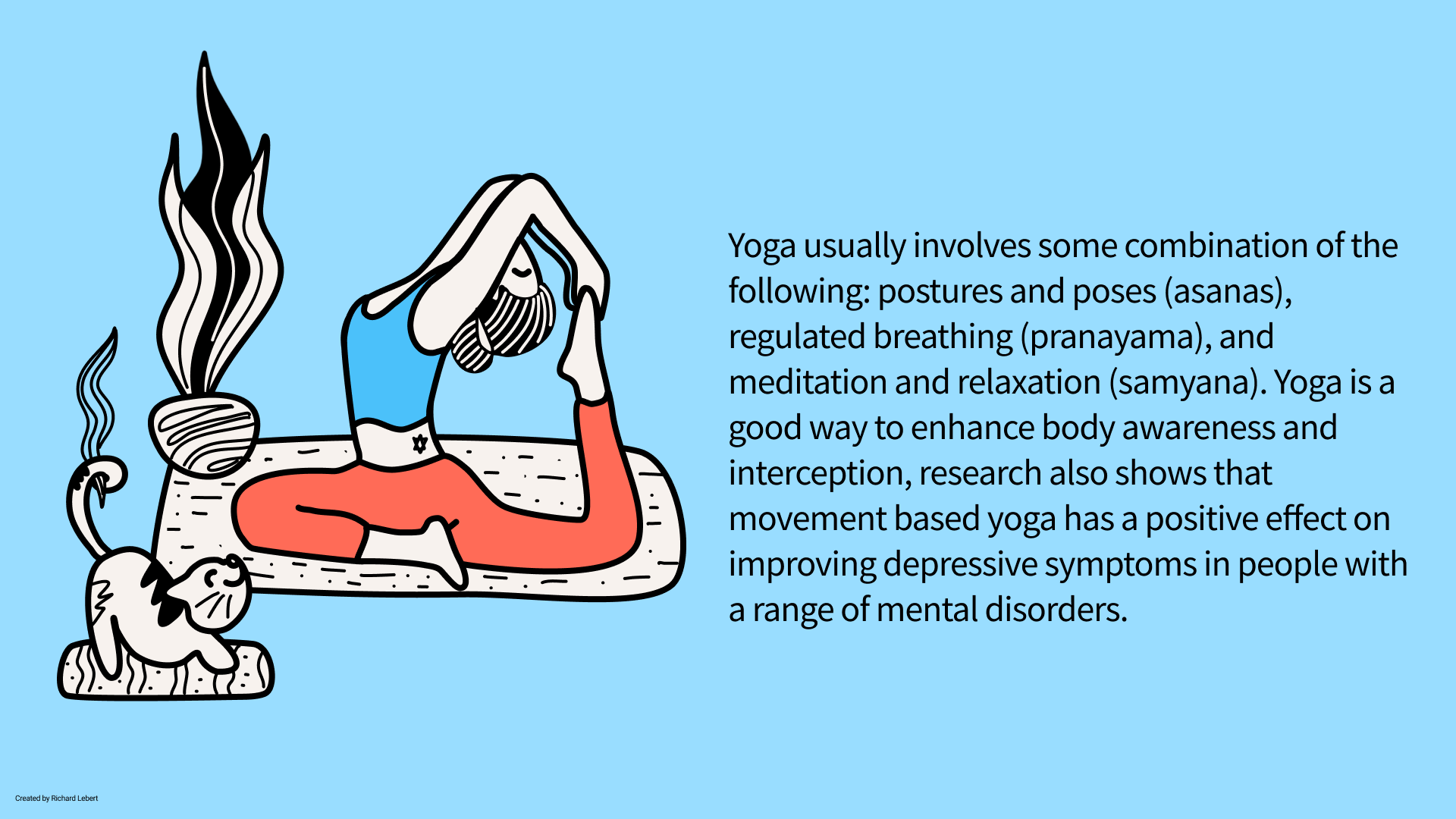
Yoga usually involves some combination of the following: postures and poses (asanas), regulated breathing (pranayama), and meditation and relaxation (samyana). Yoga is a good way to enhance body awareness and interception, research also shows that movement based yoga has a positive effect on improving depressive symptoms in people with a range of mental disorders (Brinsley et al., 2021).
Key Takeaways
Increasingly people are looking for alternative pain management strategies. The difficulty with mindfulness-based interventions is that it is not a one size fits all, what works for one person may not work for another, so it is important to try different approaches. The next step for researchers is to investigate what sort of dosage and duration would be needed to optimize the effects of this non-pharmacological approach.
References and Sources
With over 15 years of clinical experience and extensive study of massage therapy research, I'm committed to creating resources that foster the professional development of massage therapists globally. Whether you're a seasoned massage therapist or a curious newcomer, this massage therapy glossary is here to be your one-stop shop for understanding terms as it relates to massage therapy. Additionally this post highlights a substantial body of evidence supporting the use of massage therapy in alleviating pain and enhancing quality of life across a range of health issues.
This is a selection of sources I used to help formulate my ideas based on over-lapping concepts from massage therapy, physiotherapy, chiropractic, osteopathy, lifestyle medicine and traditional healing approaches.
Alaiti, R. K., Castro, J., Lee, H., Caneiro, J. P., Vlaeyen, J., Kamper, S. J., & da Costa, M. F. (2022). What Are the Mechanisms of Action of Cognitive-Behavioral, Mind-Body, and Exercise-based Interventions for Pain and Disability in People With Chronic Primary Musculoskeletal Pain?: A Systematic Review of Mediation Studies From Randomized Controlled Trials. The Clinical journal of pain, 38(7), 502–509. https://doi.org/10.1097/AJP.0000000000001047
Brinsley, J., Schuch, F., Lederman, O., Girard, D., Smout, M., Immink, M. A., Stubbs, B., Firth, J., Davison, K., & Rosenbaum, S. (2021). Effects of yoga on depressive symptoms in people with mental disorders: a systematic review and meta-analysis. British journal of sports medicine, 55(17), 992–1000. https://doi.org/10.1136/bjsports-2019-101242
Chen, W. G., Schloesser, D., Arensdorf, A. M., Simmons, J. M., Cui, C., Valentino, R., Gnadt, J. W., Nielsen, L., Hillaire-Clarke, C. S., Spruance, V., Horowitz, T. S., Vallejo, Y. F., & Langevin, H. M. (2021). The Emerging Science of Interoception: Sensing, Integrating, Interpreting, and Regulating Signals within the Self. Trends in neurosciences, 44(1), 3–16. https://doi.org/10.1016/j.tins.2020.10.007
Cohen, A. A., Picard, M., Beard, J. R., Belsky, D. W., Herbstman, J., Kuryla, C. L., Liu, M., Makarem, N., Malinsky, D., Pei, S., Wei, Y., & Fried, L. P. (2025). Intrinsic health as a foundation for a science of health. Science advances, 11(25), eadu8437. https://doi.org/10.1126/sciadv.adu8437
Darnall, B. D., Roy, A., Chen, A. L., Ziadni, M. S., Keane, R. T., You, D. S., Slater, K., Poupore-King, H., Mackey, I., Kao, M. C., Cook, K. F., Lorig, K., Zhang, D., Hong, J., Tian, L., & Mackey, S. C. (2021). Comparison of a Single-Session Pain Management Skills Intervention With a Single-Session Health Education Intervention and 8 Sessions of Cognitive Behavioral Therapy in Adults With Chronic Low Back Pain: A Randomized Clinical Trial. JAMA network open, 4(8), e2113401. https://doi.org/10.1001/jamanetworkopen.2021.13401
Dossett, M. L., Fricchione, G. L., & Benson, H. (2020). A New Era for Mind-Body Medicine. The New England journal of medicine, 382(15), 1390–1391. https://doi.org/10.1056/NEJMp1917461
Fabiano, N., Solmi, M., Kroenke, K., Stubbs, B., Firth, J., Gaughran, F., Machaczek, K. K., Palmer, C., & Fiedorowicz, J. G. (2026). The imaginary divide between mental and “physical” health: Dismantling dualism and reductionism to address a monumental mistake in medicine. JCPP Advances, e70123. https://doi.org/10.1002/jcv2.70123
Furman, D., Campisi, J., Verdin, E., Carrera-Bastos, P., Targ, S., Franceschi, C., Ferrucci, L., Gilroy, D. W., Fasano, A., Miller, G. W., Miller, A. H., Mantovani, A., Weyand, C. M., Barzilai, N., Goronzy, J. J., Rando, T. A., Effros, R. B., Lucia, A., Kleinstreuer, N., & Slavich, G. M. (2019). Chronic inflammation in the etiology of disease across the life span. Nature medicine, 25(12), 1822–1832. https://doi.org/10.1038/s41591-019-0675-0
Garland, E. L., Hanley, A. W., Nakamura, Y., Barrett, J. W., Baker, A. K., Reese, S. E., Riquino, M. R., Froeliger, B., & Donaldson, G. W. (2022). Mindfulness-Oriented Recovery Enhancement vs Supportive Group Therapy for Co-occurring Opioid Misuse and Chronic Pain in Primary Care: A Randomized Clinical Trial. JAMA internal medicine, 182(4), 407–417. https://doi.org/10.1001/jamainternmed.2022.0033
Garland, E. L., Hanley, A. W., Hudak, J., Nakamura, Y., & Froeliger, B. (2022). Mindfulness-induced endogenous theta stimulation occasions self-transcendence and inhibits addictive behavior. Science advances, 8(41), eabo4455. https://doi.org/10.1126/sciadv.abo4455
Jinich-Diamant, A., Garland, E., Baumgartner, J., Gonzalez, N., Riegner, G., Birenbaum, J., Case, L., & Zeidan, F. (2020). Neurophysiological Mechanisms Supporting Mindfulness Meditation-Based Pain Relief: an Updated Review. Current pain and headache reports, 24(10), 56. https://doi.org/10.1007/s11916-020-00890-8
Kligler, B., Bonnet, J., Dahmer, S., Jonas, W., Kreitzer, M., Krist, A., & Rw, S. (2026). Whole Person Health Care: A Way Forward. American journal of lifestyle medicine, 15598276261440796. Advance online publication. https://doi.org/10.1177/15598276261440796
Laukkonen, R. (2026). Clear Mind: Meditation and the Brain's Signal-to-Noise Ratio. arXiv preprint arXiv:2606.29698.
Lee, S., Yoon, S. I., Liao, H. Y., Kim, J. W., Lee, I. S., & Chae, Y. (2026). Listen to your inner body: embodied emotions in predictive neuroscience and traditional East Asian medicine. Frontiers in human neuroscience, 20, 1807034. https://doi.org/10.3389/fnhum.2026.1807034
Lei, D., & Djedovic, A. P. A. (2025). The Synergistic Mind-Body Hypothesis: A Daoist Approach to Consciousness from the Perspective of Traditional Chinese Medicine. Canadian Undergraduate Journal of Cognitive Science, 8.
Loewenthal, J., Berning, M. J., Wayne, P. M., Eckstrom, E., & Orkaby, A. R. (2024). Holistic frailty prevention: The promise of movement-based mind-body therapies. Aging cell, 23(1), e13986. https://doi.org/10.1111/acel.13986
Mark, A., & Wang, C. (2026). Reflections on 20 Years of Research on Tai Chi for Chronic Musculoskeletal Pain: An Updated Review. Current rheumatology reports, 28(1), 30. https://doi.org/10.1007/s11926-026-01239-7
Minelli, A. (2026). The mind-body-world unity: the predictive mind and the allostatic paradigm as a bridge between neuroscience and Traditional Chinese Medicine. A conceptual review. Brain Behavior and Immunity Integrative, 100158.
Peng, B. (2025). Embodying the Cosmos: Taoism Bodily Philosophy, Chinese Medicine, and Relational Body. Recherches & éducations, (30-31).
Quinlan, E. B., Baumgartner, J., Chen, W. G., Weber, W., Horgusluoglu, E., & Edwards, E. (2024). Promoting salutogenic pathways to health through complementary and integrative health approaches. Frontiers in psychology, 15, 1473735. https://doi.org/10.3389/fpsyg.2024.1473735
Riegner, G., Posey, G., Oliva, V., Jung, Y., Mobley, W., & Zeidan, F. (2023). Disentangling self from pain: mindfulness meditation-induced pain relief is driven by thalamic-default mode network decoupling. Pain, 164(2), 280–291. https://doi.org/10.1097/j.pain.0000000000002731
Sharpe, L., Richmond, B., Menzies, R. E., Forrest, D., Crombez, G., & Colagiuri, B. (2024). A synthesis of meta-analyses of mindfulness-based interventions in pain. Pain, 165(1), 18–28. https://doi.org/10.1097/j.pain.0000000000002997
Sturgeon, J. A., Zubieta, C., Kaplan, C. M., Pierce, J., Arewasikporn, A., Slepian, P. M., Hassett, A. L., & Trost, Z. (2024). Broadening the Scope of Resilience in Chronic Pain: Methods, Social Context, and Development. Current rheumatology reports, 10.1007/s11926-024-01133-0. Advance online publication. https://doi.org/10.1007/s11926-024-01133-0
Wayne, P. M., Ahn, A., Clark, J., Irwin, M. R., Kong, J., Lavretsky, H., Li, F., Manor, B., Mehling, W., Oh, B., Seitz, D., Tawakol, A., Tsang, W. W. N., Wang, C., Yeung, A., & Yeh, G. Y. (2025). The Science of Tai Chi and Qigong as Whole Person Health-Part I: Rationale and State of the Science. Journal of integrative and complementary medicine, 31(6), 499–520. https://doi.org/10.1089/jicm.2024.0957
Yeh, G. Y., Ahn, A., Clark, J., Irwin, M. R., Kong, J., Lavretsky, H., Li, F., Manor, B., Mehling, W., Oh, B., Seitz, D., Tawakol, A., Tsang, W. W. N., Wang, C., Yeung, A., & Wayne, P. M. (2025). The Science of Tai Chi and Qigong as Whole Person Health-Part II: Evidence Gaps and Opportunities for Future Research and Implementation. Journal of integrative and complementary medicine, 31(6), 521–534. https://doi.org/10.1089/jicm.2024.0958
Wang, Y., & Hui, K. K. (2026). Moving beyond disease-centered care toward whole-person health. Integrative medicine research, 15(3Part B), 101361. https://doi.org/10.1016/j.imr.2026.101361
Wells, R. E., O'Connell, N., Pierce, C. R., Estave, P., Penzien, D. B., Loder, E., Zeidan, F., & Houle, T. T. (2021). Effectiveness of Mindfulness Meditation vs Headache Education for Adults With Migraine: A Randomized Clinical Trial. JAMA internal medicine, 181(3), 317–328. https://doi.org/10.1001/jamainternmed.2020.7090
Weng, H. Y., Feldman, J. L., Leggio, L., Napadow, V., Park, J., & Price, C. J. (2021). Interventions and Manipulations of Interoception. Trends in neurosciences, 44(1), 52–62. https://doi.org/10.1016/j.tins.2020.09.010
Zhang, L., Lopes, S., Lavelle, T., Jones, K. O., Chen, L., Jindal, M., Zinzow, H., & Shi, L. (2022). Economic Evaluations of Mindfulness-Based Interventions: a Systematic Review. Mindfulness, 13(10), 2359–2378. https://doi.org/10.1007/s12671-022-01960-1